Larry Fink warns that AI could become the next crisis for the new generation of workers. “AI is changing at a rapid pace, and we’re not adapting fast enough,” said the CEO of BlackRock, the world’s largest asset manager. For several years now, SaaS companies have beenthe holy grailin M&A when it comes to added value and high valuations. Yet that seems to be changing. Or is that only partly true?
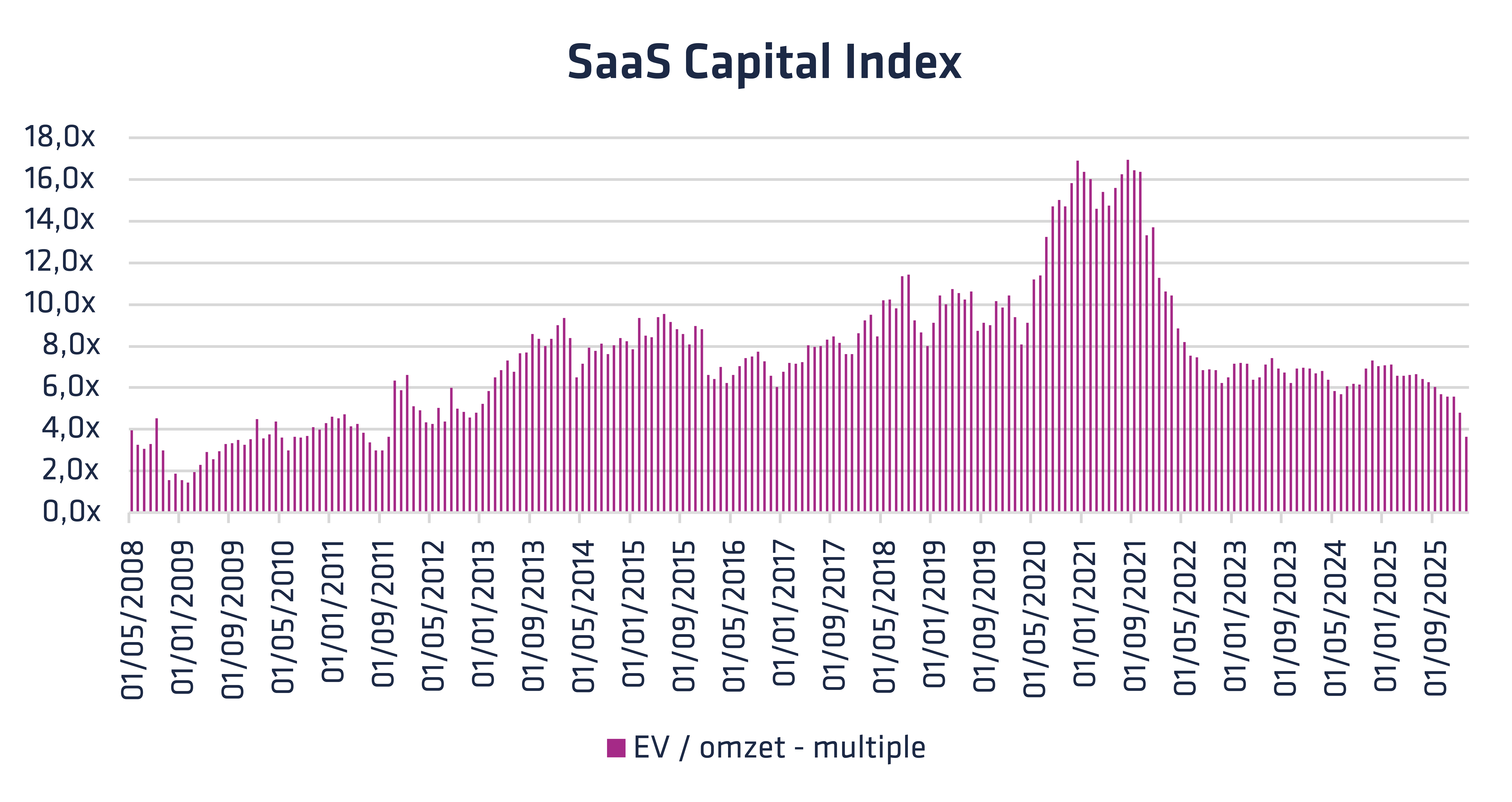
The chart below shows that, following the “hype” in 2020–2021, the average revenue multiple for SaaS companies was around 6x to 7x revenue. In recent months, however, a decline has become apparent, coinciding with the latest developments surrounding OpenAI and Claude. These lower valuations are currently driven primarily by market sentiment.
What does that mean for business owners?
As Hogenhouck M&A, we naturally speak with many investors and (tech) entrepreneurs in the mid-market segment. There is a great deal of uncertainty surrounding this issue. The trend described above is general, but ultimately, it is the application and added value that are decisive in your business model—and therefore the most interesting aspects. It is clear that hourly billing models are under pressure. Routine tasks, in particular, are increasingly being taken over by AI platforms. We see this firsthand in our daily work as M&A advisors.
At the same time, there are definitely opportunities within the software sector. The type of application and the underlying infrastructure have become more important in how the market values SaaS or your company. Standard, user-based solutions are certainly under pressure, especially when they are primarily UI-based. The opportunities, in fact, lie in the area of complexity.
What exactly does that mean? Consider, for example, ownership of underlying data—which many software applications possess and which makes these applications highly valuable. Another example is the focus on specific verticals or niche markets, such as logistics software, where numerous integrations with carriers and APIs are crucial to development. Moreover, such propositions are typically characterized by complex implementations and the associated customer lock-in.
In addition to the impact of AI on pure SaaS applications, we actually see opportunities for software developers and other IT service providers growing. This does, however, involve embracing AI applications as a value proposition for the market. If your company succeeds in making that shift and partnering with AI, the world will still be at your feet.